Timescan
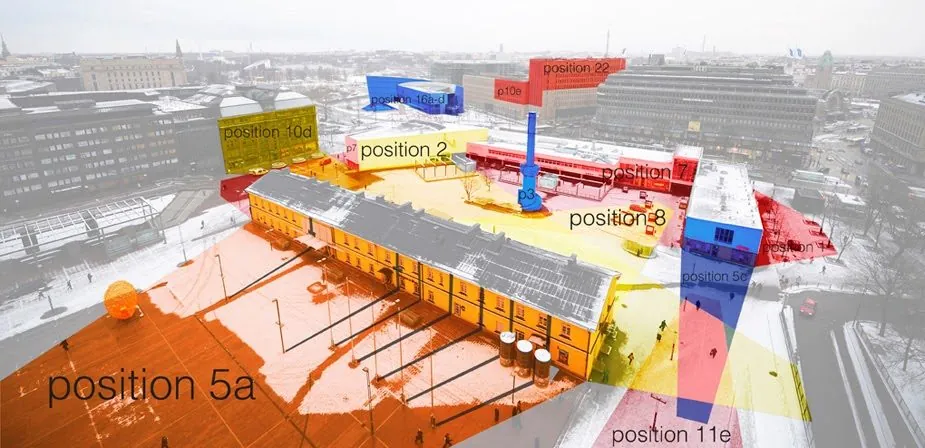
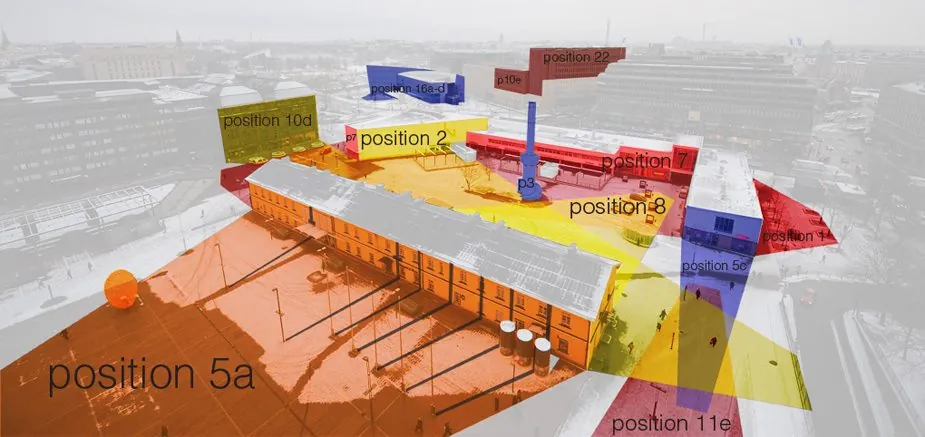
Moving light installation: 24 positions within 4 days, one platform moving around Lasipalatsi, 3 projectors.
- Date
- Place
- Lasipalatsi area, Mannerheimintie
- City
- Helsinki, Finland
- Projection
- 3 projectors, 3 × 85,000 ANSI lumen, 3 × 500 m²[1]
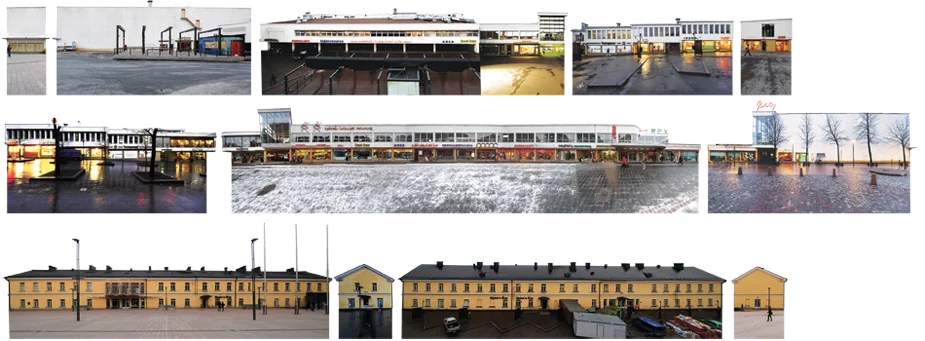
Daily hours: 17:00 to 02:00. 24 positions within 4 days, 1 platform moving around Lasipalatsi, 3 projectors with slide changers, 3 × 6 kW electric power, 3 × 85,000 ANSI lumen, 3 × 500 m² projected surface. The images show the installation on Lasipalatsi and on Kiasma.[2]
Peter Kozma (1961) is a Hungarian-Swiss visual artist who uses a high-power Pani slide projector system to project images, thoughts, and visualizations onto an area of thousands of square meters, creating new kinds of architectural spaces within the city – even in locations we imagined to be empty. The moving light installation reflects on our concepts of the city in the information age.
The light installation attempts to illuminate the interdependence of the city and art. Kozma explores the extent to which a networked culture has altered our sense of space.
The four-day light installation is preceded by months of work. Twilight and the luminosity of the evening give the work a completely different color scale than daylight. All buildings and surface structures have their own light-reflecting properties, the variable factors of which must be taken into account when programming the lights.
The purpose of the 3D visual design is to make a strong impact on people's imagination, to shake up the senses, and to get people out of their accustomed patterns to observe everyday urban space with altered fundamental concepts. By projecting a large amount of skillfully mixed light onto the structures, the buildings enter into a dialogue with their own character, enabling a new spatial sensation for the viewer.
28.2.–2.3. Several illuminated sites in the surroundings of Lasipalatsi.
Peter Kozma (1961) on unkarilais-sveitsiläinen kuvataiteilija, joka heijastaa suuritehoisella Pani-diaprojektorijärjestelmällä kuvia, ajatuksia ja mielikuvia tuhansien neliömetrien alueelle ja saa aikaan uudenlaisia arkkitehtonisia tiloja kaupunkiin – myös sellaisiin kohteisiin, jotka kuvittelimme tyhjiksi. Liikkuva valoinstallaatio pohtii kaupunkikäsitteitämme informaation aikakaudella.
Valoinstallaatio yrittää valottaa kaupungin ja taiteen riippuvuutta toisistaan. Kozma tutkii missä määrin tietoverkostunut kulttuuri on muuttanut tilantunnettamme.
Nelipäiväistä valoinstallaatiota edeltää kuukausien työ. Hämärä ja illan valoisuus antavat teokselle aivan eri väriskaalan kuin päivänvalo. Kaikilla rakennuksilla ja pintarakenteilla on oma valonheijastamisominaisuutensa, jonka muuttuvat tekijät on valojen ohjelmoinnissa pystyttävä ottamaan huomioon.
3D-näkymäsuunnitelmalla on tarkoitus tehdä vahva vaikutus ihmisten mielikuvitukseen, ravistella aisteja, saada ihmiset ulos totutuista kuvioista havainnoimaan jokapäiväistä kaupunkitilaa muuttuneilla peruskäsitteillä. Heijastamalla suuri määrä taitavasti sekoitettua valoa rakenteisiin rakennukset joutuvat dialogiin karakterinsa kanssa, mikä mahdollistaa katsojalle uuden tila-aistimuksen.
28. 2.–2.3. Lasipalatsin ympäristössä useita valaistuja kohteita
Project team
- Peter Kozma - Concept and direction, project leader
- Attila Sütő - Project management
- Gly - Production management
- Zoltán Ferenczi - Junior art director
- Béla Hegyi - Visual design
- András Herczku - Visual design
- Paulina Chmurzyńska - Graphic design
- Zsolt Fekete - Photography
- Endre Somogyi - Photography
- Zoltan Téglási - Photography
- Örs Szigeti - Video
- Peter Nagy - Production
- Michael Romana - video[2]
Reuters Screenocean footage record "Helsinki"[1]: https://reuters.screenocean.com/record/580293.
Images
Photographs: Peter Kozma Archive. The photographers of the Light Art Installation project were Zsolt Fekete, Endre Somogyi and András Végh, "and many others"; individual credits are not known.